
Reviewed · AKROTIRI & ANCIENT THERA
Santorini: Experience Akrotiri with a Licensed Tour Guide
Akrotiri feels like a time machine. This private guided walk takes you into a 4,000-year-old prehistoric city preserved under volcanic ash, and it is the kind of place where a guide turns scattered ruins into a real living neighborhood. I especially love how Georgia helps you see everyday life in the layout, from paved lanes to the kinds of rooms people used.
The biggest heads-up is simple: 75 minutes is fast, so if you want to slow-walk for hours or take tons of close-up photos, you may feel a little time pressure.
Key highlights worth planning for
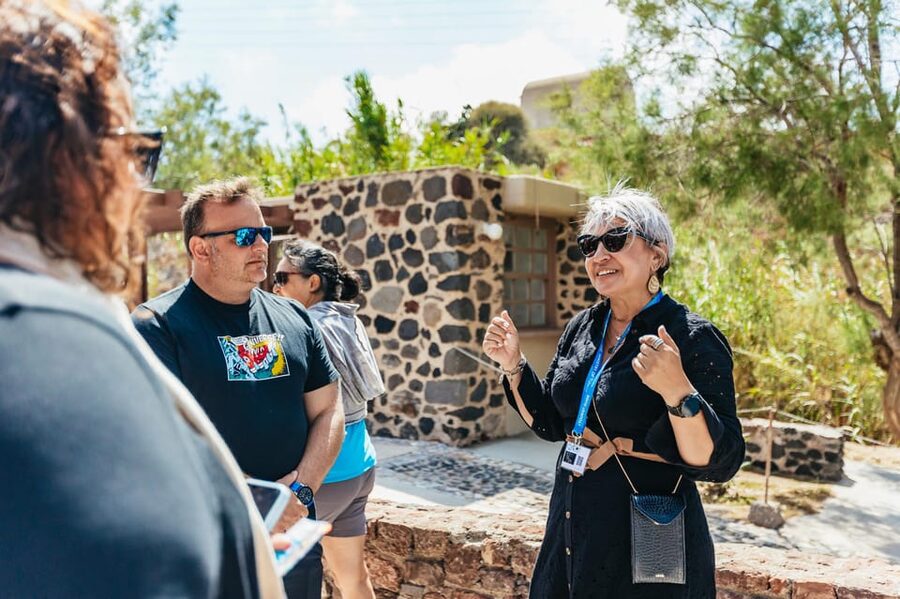
- Licensed guide right at Akrotiri’s entrance, so you start with context instead of guessing
- Paved streets, squares, and multi-story buildings, laid out like a functioning town
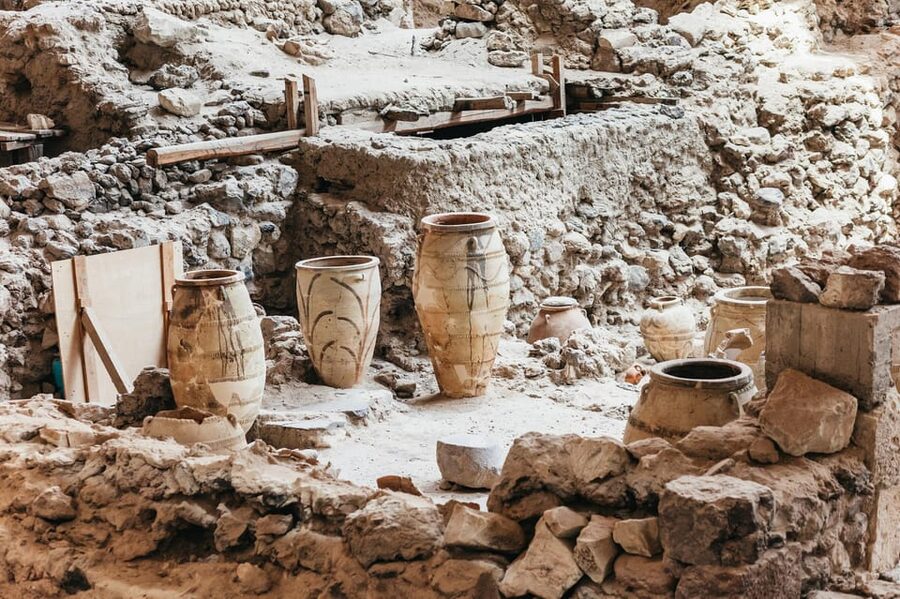
- Kitchens, toilet facilities, and a drainage system, proof of serious planning
- Recreated wall painting views via photos shown during the walk
- Eruption and Bronze Age explanations, plus theories that connect Akrotiri to Atlantis
- Private group experience, with time to ask questions and adjust the pace
Akrotiri’s paved time capsule: 4,000 years in 75 minutes

Akrotiri is the “how did humans even build this” stop on Santorini. The city was buried by volcanic ash after a major eruption around 1600 B.C., and what survives is unusually intact for something that old. Instead of wandering through a few foundations and hoping you can picture the rest, you walk through the skeleton of a whole settlement.
In this tour, the time adds up fast. The core walk is about 70 to 75 minutes, which means you spend enough time to understand the major neighborhoods of the site, without the visit dragging into fatigue. I like that balance, especially on Santorini, where heat, crowds, and transfers can eat your day.
Also, this is a guided experience focused on interpretation. You are not just reading placards. You are learning how the settlement was organized, how people lived inside multi-story complexes, and why the site looks the way it does today.
Buried streets and hilltop ruins, more to dig into
- Santorini: Experience Akrotiri with a Licensed Tour Guide★ 4.9 · 229 reviews
- Archaeological Bus Tour to Akrotiri Excavations & Red Beach★ 4.5 · 150 reviews
- Private Cultural Villages Sightseeing & Akrotiri Excavations★ 5.0 · 135 reviews
Meeting your licensed guide at the site entrance (and why it matters)
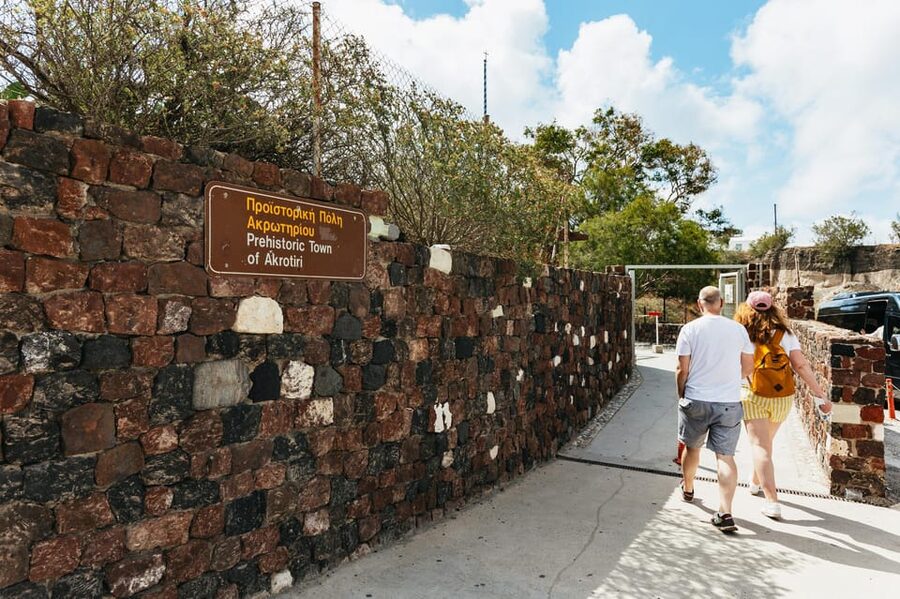
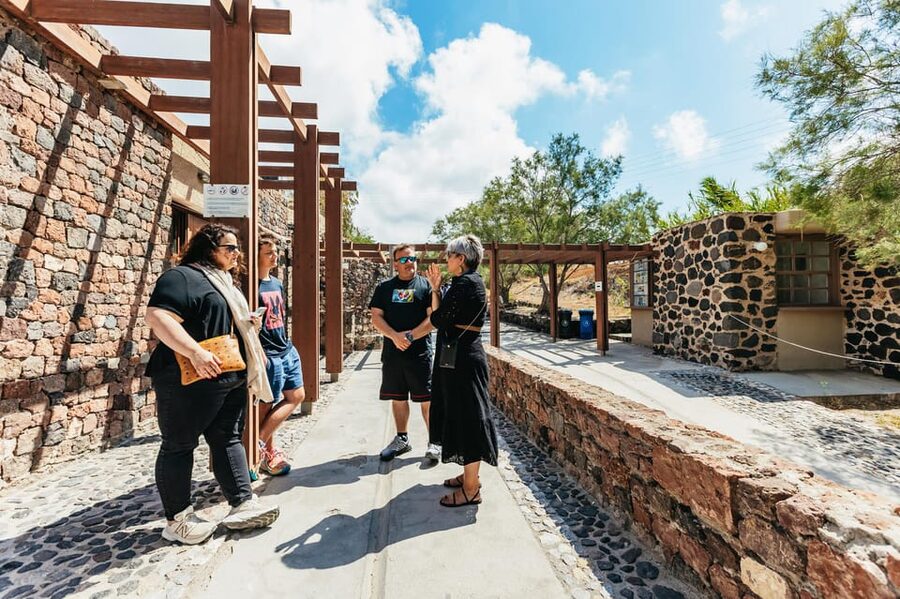
You meet your guide right at the Akrotiri archaeological site entrance, across from the cashier. That detail sounds small, but it changes your whole first five minutes. You get oriented immediately, you get your tickets sorted, and you start walking with a framework for what you are about to see.
This matters because Akrotiri is not laid out like a typical museum. You are moving through open-air ruins, and a lot of the “meaning” is not obvious at a glance. With a licensed guide, you get direction to the spots that show the clearest evidence of daily life, including areas with paved streets and drainage.
Language is another practical win. The tour runs in English, and the guide is live, not audio-only. Based on how the experience is described, Georgia also supplements explanations with photos of what used to be on the walls, which helps you understand features that do not survive the same way today.
What you’ll see: streets, squares, and multi-story building complexes
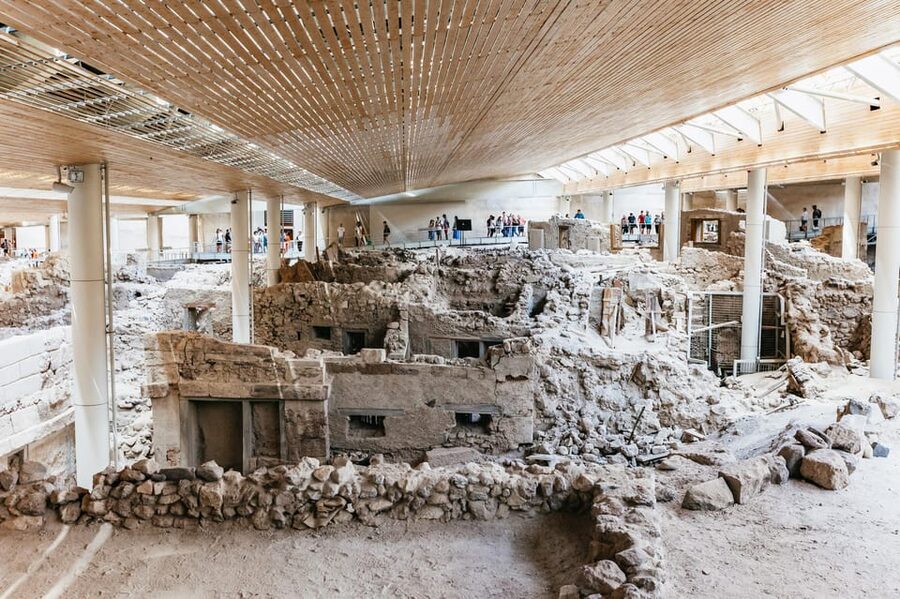
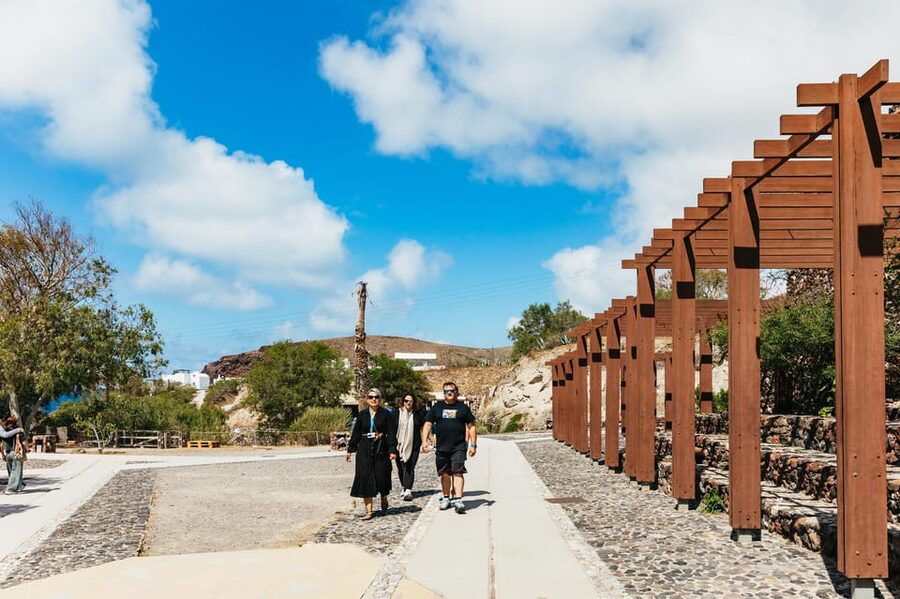
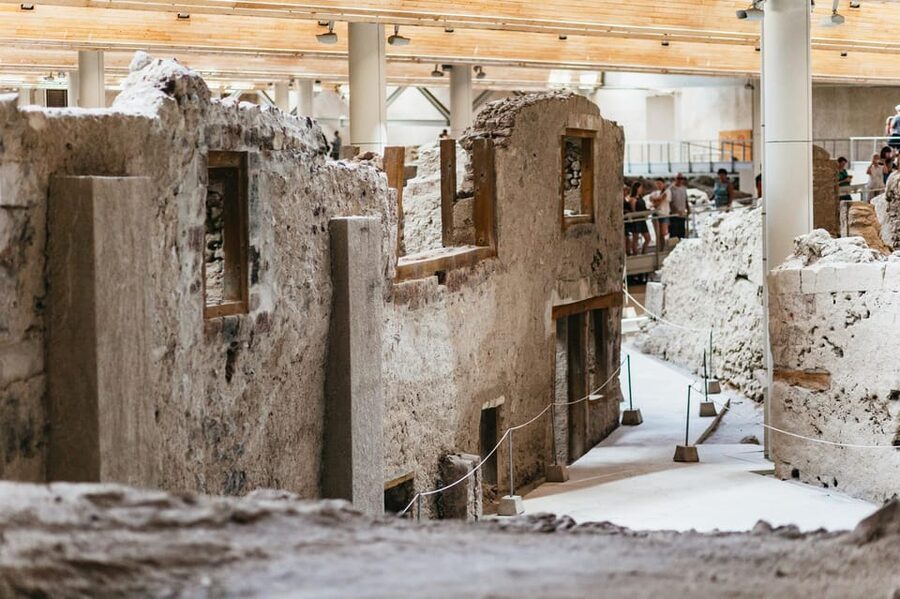
The best part of Akrotiri is how “town-like” it feels. You stroll through paved streets and squares, and you can start to sense how people moved around and where the community gathered. Even if you are not a history nut, that kind of physical layout is easy to grasp: streets connect places, squares create shared space, and buildings cluster the way they did for a reason.
During the tour, you also focus on buildings that were about 2 to 3 stories high. Seeing those levels helps you stop thinking of Akrotiri as a few scattered walls. Instead, you realize you are looking at dense construction, with rooms stacked and connected. In practice, that changes how you interpret doorways, walls, and interior spaces.
One of the underrated benefits of a guided walk is that you do not have to guess which ruins matter most. Your guide points out what the remains suggest about how the town was structured and what kinds of spaces you are actually standing in. Without that, it is easy to admire the site but miss the “why.”
Kitchens, toilets, and drainage: the day-to-day proof of advanced planning
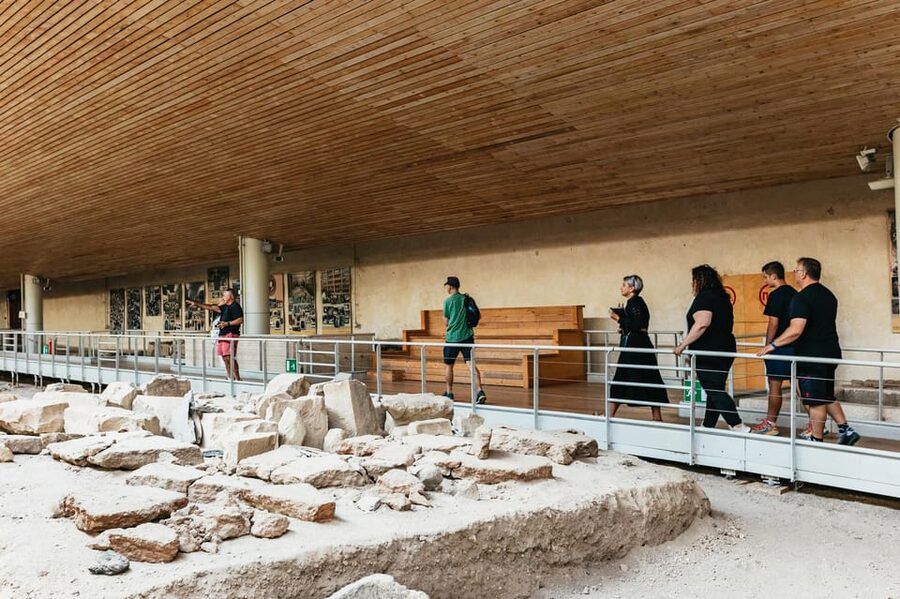
Akrotiri is famous in part because it is not only dramatic walls and big structures. It is also the small, practical things that make the civilization feel real.
On this tour, you will specifically see evidence for kitchens and toilet facilities. You will also learn about the settlement’s drainage system. These details are the difference between “cool ruins” and “wow, people lived here with real infrastructure.”
Why does this matter for you? Because it gives you a fast reality check about Bronze Age life. When you can point to plumbing-like function, waste management, and a drainage layout, you can stop treating the past as a vague “then people were different” idea. You start treating it like a place with routines, needs, and solutions.
Your guide also helps connect those features to broader questions like how homes were organized and how a community might have kept everyday systems working. That is what turns scattered evidence into a coherent picture.
Line these up before you settle on this Santorini trip:



Wall paintings and the eruption story that explains the silence
A lot of Akrotiri’s personality comes from things that are not fully visible today. Many wall paintings and decorative elements did not survive in their original form, but the underlying story is documented through excavations and study.
This is where your guide’s tools make the difference. Georgia shows photos of the original wall paintings that used to decorate buildings. Even if you are standing in a bare room now, those images help you understand what the interiors might have looked like. It also helps you connect the building surfaces to their former purpose, instead of assuming everything was plain.
Then you layer in the eruption story. The site is preserved because it was buried by volcanic ash after a powerful eruption around 1600 B.C. That timing is not just a date on a sign. It is the reason the city becomes a rare kind of snapshot in time. You get a feel for why Akrotiri is so important archaeologically, and why “walking the streets” feels different here than at many other ruins.
If you like big stories with human consequences, you will appreciate how the tour connects the physical evidence to what must have happened to daily life. It is not just tragedy, it is preservation.
Atlantis theories, modern explanations, and how to read what you see
One of the fun, brain-friendly parts of Akrotiri is that it pushes into mythology and interpretation. Your guide discusses theories that connect the site with the myth of the lost city of Atlantis.
This is best approached with the right mindset: theories, not certainties. Still, it is a useful way to practice “reading” the ruins. When you hear how researchers interpret different features, you start noticing which parts are clearer evidence and which parts are more speculative. That helps you enjoy the site without getting stuck in either fantasy or frustration.
You will also hear how society may have been organized and how people lived day to day. The tour spends time on how the layout hints at social and practical organization. For example, streets and squares imply shared movement and gathering. Multi-story buildings imply how space was used when people needed more rooms or more activity under one roof.
And because this is a private guided experience, you can ask follow-up questions on whatever grabs you most: architecture, everyday utilities, or how the eruption and preservation changed what we know today. That back-and-forth is a major part of why the experience gets such strong marks.
Skip the ticket line, keep the pace, and know what to bring
There are two small logistics wins that make the visit easier. First, the tour includes a skip-the-ticket line approach, which helps if you are dealing with heat and limited daytime time. Second, you start at the entrance and go straight into the walk, so you are not wandering around trying to “figure it out” alone.
Duration is tight, so planning helps. Wear shoes you trust on uneven stone, and bring your camera. The tour notes that food and drinks are not allowed, which means you should treat this as a pure site visit. If you want a snack later, plan it after the tour rather than bringing it with you.
Opening hours can change, and the tour time will be confirmed by the provider by email. That is worth taking seriously in practice. Santorini days are busy. A quick email check the day before can save you from arriving at the wrong time window.
Wheelchair access is listed as available, so you can feel more comfortable about accessibility planning than at many open-air sites.
Price and value: why $198 can be worth it at Akrotiri
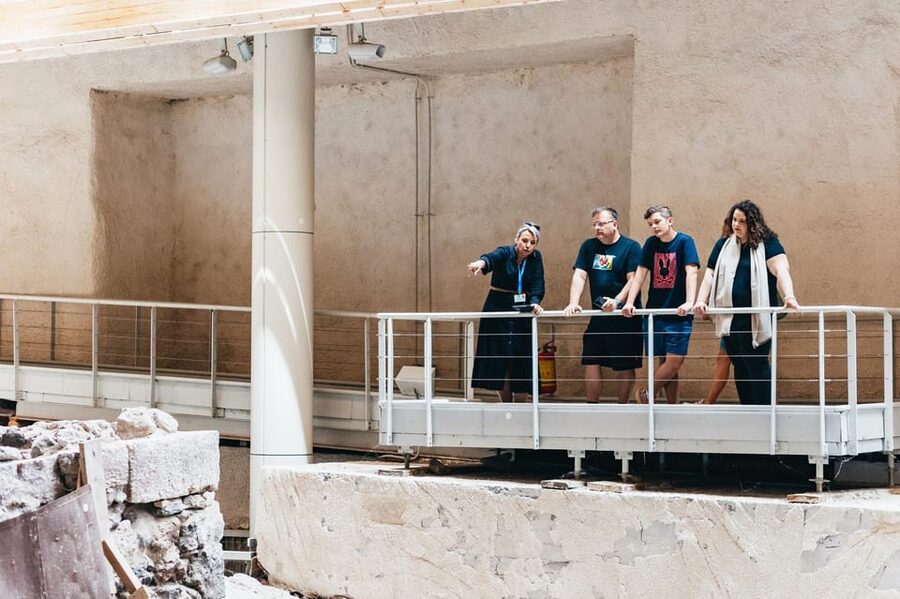
At $198 per group, the price is not “cheap,” especially if you compare it to wandering unguided. But Akrotiri is one of those places where interpretation is the product. You are paying for a licensed guide who can explain what you are looking at, in the order that makes sense, with context that you cannot easily reconstruct from signs alone.
Here is how I think about the value:
- The guide saves guesswork. Akrotiri’s ruins can look like a maze if you do not know what you are seeing. A guide points you toward the meaningful pieces, so you leave with a coherent story.
- You get inside-level context. Seeing kitchens, toilets, and drainage is more satisfying when someone explains what the layout suggests and how archaeologists interpret it.
- You get visual reconstruction. The wall painting photos shown during the walk are a real “only with a guide” benefit. Without that, you might walk right past what you cannot reconstruct on your own.
- It is private and paced for questions. Reviews describe a patient, discussion-friendly approach, which matters if you have kids, questions, or you just want to understand more deeply without feeling rushed.
One consideration: because the guided portion is about 75 minutes, this is not a “slow pilgrimage” type of visit. If you want to linger at every corner, you may still enjoy it, but you will likely want to plan extra time before or after (on your own) for wandering.
In short, I see this tour as a value buy if you care about understanding the site beyond surface impressions.
Who this Akrotiri guide walk suits best
This is a strong fit if you fall into any of these categories:
- You like ruins with a clear “how did people live” angle, not just dramatic architecture.
- You want a guided visit that helps you picture the Bronze Age city in motion, from streets to building interiors.
- You appreciate clear explanations and room for questions, since the format is private.
- You are visiting Santorini on a limited schedule and want a high-impact, focused experience.
It is also a good choice if you are not a museum person. Akrotiri works because it feels like a real town under your feet. The guide’s job is to help you connect the stones to human choices.
Should you book this Akrotiri guided tour?
Book it if you want Akrotiri to feel like a story you can understand, not just a site you can photograph. The combination of paved streets, multi-story buildings, and everyday features like kitchens, toilets, and drainage is impressive on its own, but the real payoff comes from having Georgia interpret what you are seeing and show photos of wall paintings that bring interiors back to life.
Skip it only if you are determined to do everything at your own pace without paying for interpretation, or if you know you want to spend much longer than 75 minutes in the same sections. For most people, though, a licensed guide turns Akrotiri into one of the most memorable history stops on Santorini.
FAQ
How long is the Akrotiri guided tour?
The guided tour is listed at about 70 minutes, with the activity duration shown as 75 minutes.
Where do I meet the guide?
Meet your guide at the entrance of the Akrotiri archaeological site, across from the cashier.
Is the entrance fee included in the price?
No. The entrance fee is €20 per person and is not included.
Does this tour include skipping the ticket line?
Yes. The experience lists a skip-the-ticket line option.
What language is the tour guide?
The live guide is listed as English.
Is the tour wheelchair accessible?
Yes, the tour is listed as wheelchair accessible.
Can I bring food or drinks?
Food and drinks are not allowed.
What should I bring, and can I cancel?
Bring a camera. You can cancel up to 24 hours in advance for a full refund.
More Tours in Santorini
- Santorini Caldera Cruise Tour (Volcano, Hot Springs, Thirassia)
★ 4.5 · 1,302 reviews - Santorini Wine Stories: Sunset Tour with Tasting & Dinner
★ 5.0 · 1,285 reviews - Santorini Volcano and Hot Springs Cruise Tour from Fira Old Port
★ 4.0 · 1,214 reviews - Santorini Day Tour with Sunset in Oia
★ 4.5 · 1,130 reviews - Private Santorini Sightseeing Tour – Customizable,Cruise Friendly
★ 5.0 · 717 reviews
More Tour Reviews in Santorini
- Santorini Classic Catamaran Cruise with BBQ, Drinks and Transfers
★ 5.0 · 3,933 reviews - Half-Day Exclusive Catamaran Cruise in Santorini with Meal and Open Bar
★ 5.0 · 2,975 reviews - Santorini Gold Catamaran Cruise with Snorkel, BBQ & Open Bar
★ 4.8 · 2,822 reviews - Private Santorini Tailor Made – Choice of the Guest!
★ 5.0 · 1,972 reviews - Santorini Wine Adventure with 12 Wine Tastings, Tapas and Sunset
★ 5.0 · 1,715 reviews
Akrotiri and Ancient Thera
- Archaeological Bus Tour To Akrotiri Excavations & Red Beach
★ 4.6 · 280 reviews - Archaeological Bus Tour to Akrotiri Excavations & Red Beach
★ 4.5 · 150 reviews - Private Cultural Villages Sightseeing & Akrotiri Excavations
★ 5.0 · 135 reviews - Santorini: Akrotiri Private Guided Tour with Hotel Pick-Up
★ 5.0 · 50 reviews - Private Group Visit to Akrotiri & 3 Wineries with Tastings
★ 4.2 · 42 reviews
Just Reviewed: Fresh Santorini Trips





Akrotiri & Ancient Thera, compared.
 ★ 4.9Akrotiri: Guided Horseback Riding Day Trip to a BeachFrom $88477 reviews
 ★ 3.9Akrotiri Entry Ticket and Audio GuideFrom $41348 reviews
 ★ 4.6Archaeological Bus Tour To Akrotiri Excavations & Red BeachFrom $57280 reviews
★ 4.5Archaeological Bus Tour to Akrotiri Excavations & Red BeachFrom $59150 reviews
★ 4.6Archaeological Bus Tour To Akrotiri Excavations & Red BeachFrom $57280 reviews
★ 4.5Archaeological Bus Tour to Akrotiri Excavations & Red BeachFrom $59150 reviews
 ★ 5.0Private Cultural Villages Sightseeing & Akrotiri ExcavationsFrom $217135 reviews
 ★ 5.0Akrotiri Private Guided Tour with Hotel Pick-UpFrom $37750 reviews
 ★ 4.2Private Group Visit to Akrotiri & 3 Wineries with TastingsFrom $29442 reviews
 ★ 3.1Akrotiri Prehistoric City Guided Walking TourFrom $42436 reviews
Browse the lists this tour appears in